Why Calorie banking is making you gain body fat
...and why shifting your calories around isn't as clever as it sounds!
What is Calorie banking?
Calorie banking is having a comeback moment, and it's being sold as a flexible, "realistic" way to eat.
The premise: eat less on certain days so you can eat more on others (banking). Save calories Monday–Thursday, then spend them Friday–Sunday.
Also known as: calorie cycling, macro cycling, the "diet starts Monday" reset, or that 6-week influencer challenge with a very convincing before/after.
On paper, the math looks convincing and the process appealing. In practice, your metabolism didn't get the memo.
Let’s dig in as to why that’s the case 👉
WhY banking is appealing
Here's why people love it: the numbers seem to add up.
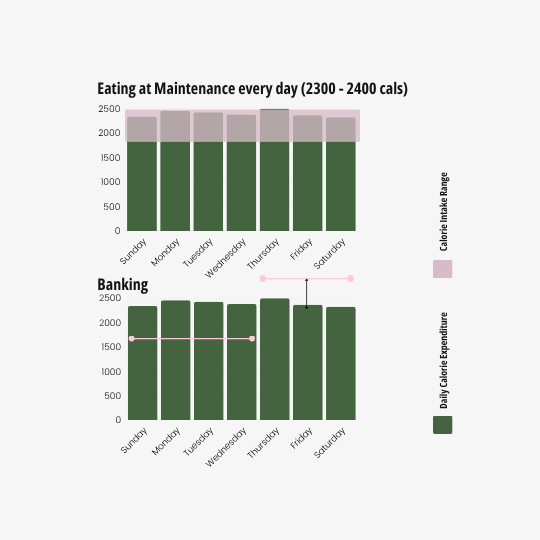
Monday - Thursday: Eat 1,850 calories
Friday - Sunday: Eat 2,900 calories
Your weekly average comes out to your maintenance targets of ~2,300 calories, with nearly unlimited fun on the weekends.
Who wouldn’t want to do that?
Except your body doesn't calculate based on a weekly average. It responds to the signals you’re sending every day.
And when those low-calorie days pile up, something happens that puts the kabosh on this “easy fat loss method”. 👉
Banking Visual
Your body adapts
When you consistently eat well below your energy needs, your body reads that as a signal: energy is scarce.
So it adapts. It downregulates your non-exercise activity (NEAT), slows thyroid output, and reduces overall metabolic rate (aka lowers your maintenance calories) all to match what you're actually giving it.
This is called metabolic adaptation, and it's not a flaw; it happens in every deficit (it’s why we can’t just stay in a deficit forever). It's your body doing exactly what it was built to do for survival.
The problem? Your "banking" strategy just made your maintenance adapt down.
Banking = Adaptations
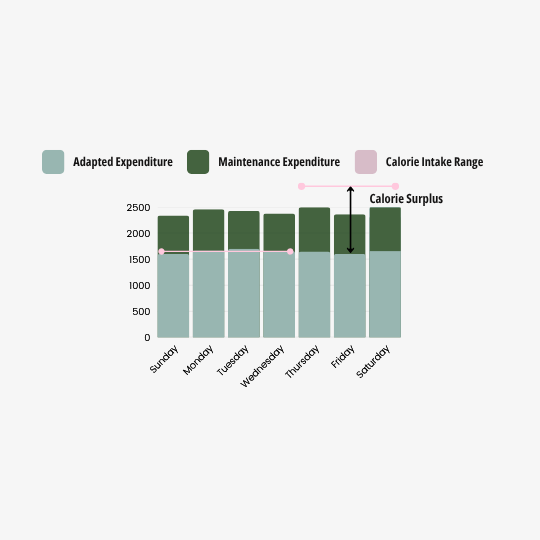
Because you’re technically in a deficit most of the week, your maintenance adapts to lower values over time.
Now, this person is averaging the same calories as when they started the program and is gaining weight. High-calorie days create a surplus, and the body stores excess calories as body fat.
You're eating the exact same weekly average as when you started and haven't changed a thing aside from banking, but you start gaining weight. This is called collateral fattening
banking in a deficit?
Now imagine you're doing this as part of a planned fat loss phase, eating even less on your low days to push the weekly average into a deficit. The problem compounds in two ways:
Issue A: Your maintenance adapts even lower to match the deeper restriction. The same high days now create an even bigger surplus = more fat storage, even as the scale drops from muscle and water loss.
Issue B: You notice it's not working, so you make your low days lower to compensate. More restriction → more adaptation → a bigger gap between your low days and high days → more fat storage on the "banking" days.
Either way, the strategy requires more restriction to produce fewer results, and often worse body composition overall.
Collateral Fattening trap
You're likely not gaining fat from eating too much every day. You're gaining weight from inconsistent eating.
The scale might even be dropping while this is happening, especially as you return to low days. You're losing muscle and water while your maintenance is adapting down.
And incrementally, on every high-calorie day, you're gaining small amounts of body fat.
Over months of banking, the net result is lower adapted maintenance, worse body composition (meaning we’ve lost more lean tissue than we’d like), and a metabolism increasingly resistant to both fat loss and weight maintenance.
How do I fix it?
So you realize you’re the person who diets Monday-Friday and YOLOs every weekend (unintentional banking)? And you see the scale creep and feel helpless?
Now is the time to actually eat at maintenance for once. Not a few days a week, but every day. By consistently eating at maintenance, you are no longer in a low energy availability state, and your body no longer needs to store every excess calorie.
Then, and only then, it will start to reverse the metabolic adaptation.
Rather than eating lower calories during the week, simply start eating at your actual calculated maintenance calories every day. You won’t want to eat more on the weekends because you’re actually feeling fed and fueled.
But what’s my maintenance?
Most people have no idea what their real maintenance calorie range is. If you've been banking, cycling, or restricting and rebounding for any length of time, your sense of "maintenance" is probably off.
And plugging your stats into a calculator won't fix it. When a calculator says "your maintenance is 1,961 calories," what it actually means is: we're 95% confident your maintenance is somewhere between 1,561 and 2,361. That's an 800-calorie range.
Your maintenance range is determined by how your body responds to consistent intake over time. And it requires your data, not a formula built on population averages, to find it.
After coaching 600+ clients through this process, we know one thing for sure: you don't find your maintenance using a generic calculator. You find it using your own data.
That's why we built the Maintenance Map: a dynamic dashboard that uses your calorie intake and daily weigh-ins to back-calculate your true maintenance range and custom protein targets based on your body, not population averages.